The most important meal of the day knows no limits. Introduction to Brinner, the Anglo-Saxon trend that, combining breakfast and dinner, is conquering social media and cafés around the world.
In the U.S., the custom has been around for a long time – it’s called breakfast for dinner, and it’s an original evening meal made up of traditional breakfast dishes. It’s a “different” meal, which viewed as a small, fun and tasty indulgence based on comfort food, as shown in scenes from films and TV shows, such as Juno or Parks and Recreation, where the characters are passionately attached to evening meals based on eggs and pancakes.
In Europe, it is a newer trend imported from the English-speaking world, although in Italy - with less glamour attached to it –, just a few decades ago it was not uncommon to have milky coffee served with bread or biscuits on the table even in the evening.
Today, this habit is spreading under the name of brinner, a neologism created from the fusion of breakfast and dinner, and is a new evolution of breakfast. This meal, not surprisingly, in recent years has demonstrated exceptional versatility, reinventing itself in the times, places, menus and socialising that accompanies it, going from soft clubbing events, where it grooves between a coffee and a brioche, to the most diverse brunch formulas. A sign, above all, of the times, where there is a yearning to slow down and dedicate more time to ourselves.
Coffee, in all these mutations, never loses its centrality.
At what time is it eaten?
This is not the first time breakfast is challenging schedule conventions. The first to step outside the boundaries of traditional scheduling was the Sunday breakfast in the 1990s with the arrival of brunch. British university students coined this term, a fusion of breakfast and lunch, to describe the habit of delaying the first meal of the day to recover from the excesses of the previous night.
It is on the other side of the world that the idea which would go on to rewrite the rules was born: in 1993 Australian chef Bill Granger opened his restaurant ‘bills’ in Sydney’s Darlinghurst district. His scrambled eggs celebrated by the New York Times, which in 2002 nicknamed him “Sydney’s Egg Master” and ricotta hotcakes turned breakfast into a meal to be enjoyed in peace, seated, at any time of day. From there, the format of restaurants serving non-stop breakfasts spread to London, Tokyo, Seoul and Europe, to become a recognisable standard in many international cities, driven by the search for more flexible, informal and rewarding experiences, including those of food, particularly by Millennials and Gen Z.
The Brinner: when breakfast wins over dinner... and social media
If brunch moves breakfast forward by a few hours, brinner brings typical morning dishes directly to cocktail hour or dinner time. A habit that, thanks to its photogenic appeal, has also been very successful on social media through the hashtag #brinner.
In Melbourne, the phenomenon even got an official festival: 2017 saw the city’s first “Brinner Fest”, celebrated by an event made up of pancakes and cereals served as the sun dips.
On its arrival in Italy, the new trend is causing one of the most deeply ingrained unwritten rules in national culture to falter: the notion that drinking a cappuccino after midday is (almost) a sacrilege.
What is on the menu for a breakfast at cocktail hour?
The selection of food for a breakfast at dinner looks mainly to the Anglo-Saxon tradition: pancakes, waffles, eggs Benedict, bacon, hashbrowns and French toast dominate, sometimes in combination with pastry specialities or breads and baked goods typical of other traditions; here the cappuccino and brioche slip in next alongside the muffins and sausages. What in one culture is a breakfast food, in fact, in another can be typical of an evening meal, and vice versa, making the boundaries of this new trend even more fluid.
The one thing that cannot be absent is coffee, which is a common denominator in every corner of the globe, so much so that it has become a universal symbol of getting out of bed and the start of the day. Whether in an espresso, cappuccino or filter version or extracted through manual brewing techniques, it is almost always at the heart of the experience. To be alternated, of course, with soft or alcoholic beverages, such as prosecco, also in its concoctions “borrowed” from brunch, such as bellini, rossini or a fresh mimosa cocktails.
What’s the best way to drink coffee at cocktail hour or brinner?
If breakfast extends into the evening, cocktails also bring their own influences to coffee. The new habit of brinner strengthens coffee’s place in the world of mixology, leading to a range of cocktails, alcohol and non-alcoholic, ideal for savouring when the sun goes down, especially when paired with some typically “morning” dishes.
Among the most popular specialities is a classic like the espresso martini, a popular choice at a bar on summer evenings.
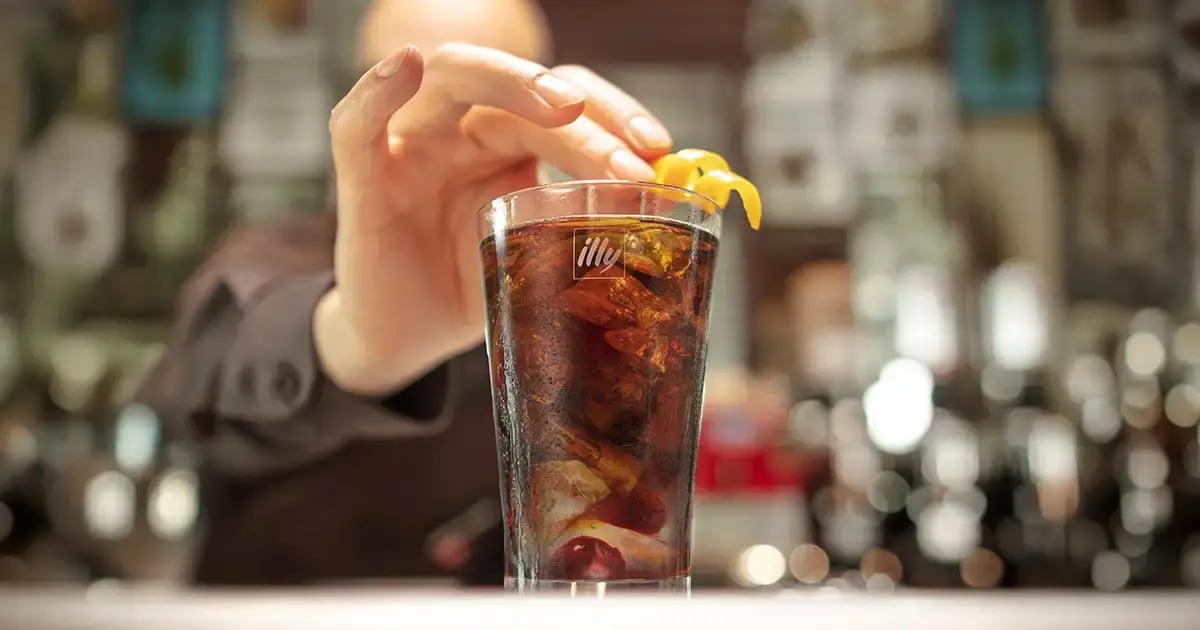
Even a classic like the Americano cocktail can be given a fresh twist. It‘s exactly what happens when the soda is replaced by coffee, more precisely a cold brew, i.e. a coffee extracted cold through a long infusion.
This version can also be prepared at home by following illy’s recipe suggestion. At any time you wish!
Ingredients
-
80 ml Cold Brew (even the illy Cold Brew Ready to Drink)
-
30 ml Campari
-
30 ml Martini Rosso
-
1 orange
-
Ice cubes
Equipment
-
Cocktail measuring cup (jigger)
-
Mixing spoon
-
300 ml glass
Preparation
-
Cool the glass.
-
Fill it with ice up to 3⁄4 full.
-
Add 30 ml of Campari, 30 ml of Martini Rosso and 80 ml of Cold Brew.
-
Stir everything with the mixing spoon.
-
Add a slice of orange.
-
Decorate the glass with the orange zest and serve.
FAQ
It’s the fusion of breakfast and dinner: the habit of eating typical breakfast dishes especially those of the Anglo-Saxon tradition at cocktail hour or dinner.
Brinner food and drink is inspired mainly by the international breakfast classics: pancakes, waffles, eggs, bacon, French toast, brioche and baked goods. Naturally, coffee accompanies the meal, with anything from espresso to cappuccino, as well as juices, soft drinks and the cocktails typical of brunch, such as mimosa, bellini and rossini.
As an alcohol or non-alcoholic cocktail. For example, enjoying a classic like an Americano in a cold brew version: a drink designed for those who love traditional cocktails but want to experience something new.